by Rianne Hill Soriano
The film kicked off with the vampire leaders digging up Dracula, the original vampire who spawned their race. An hour and 46 minutes later, it was the decent end to the Blade trilogy.
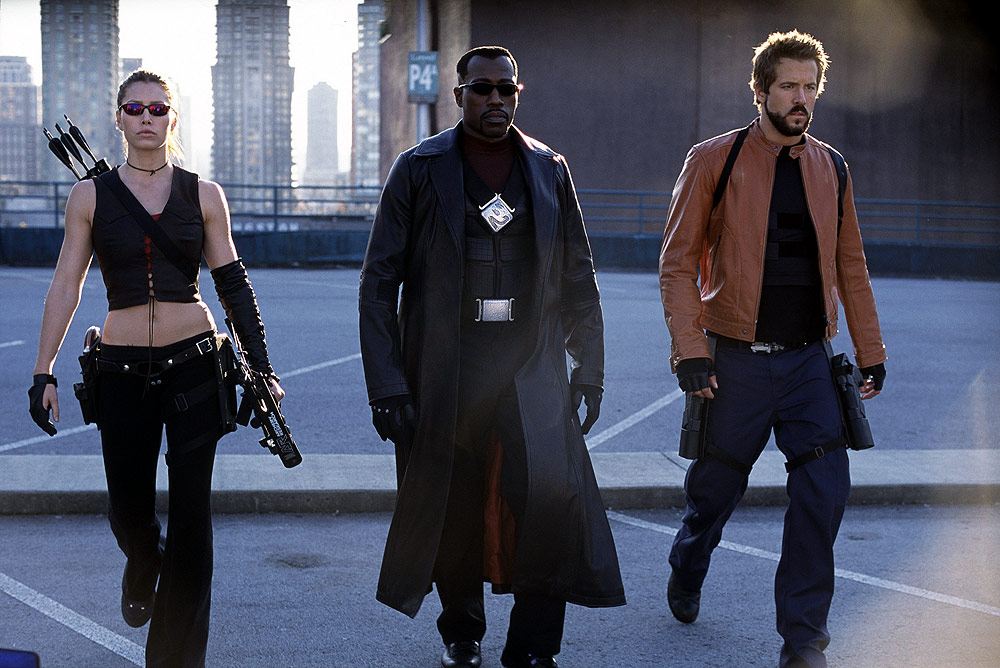
Wesley Snipes returned as the iconic vampire hunter literally exploding vamps all over. But the strategic attack of the vamps, led by the powerful Danica Talos (Parker Posey) and her fanged subordinates Asher (Callum Keith Rennie) and Grimwood (professional WWE wrestler Triple H) caused the short-time downfall of the Daywalker and his mentor, Whistler (Kris Kristofferson). And so, he reluctantly teamed up with the two young Nightstalkers – a group of human vampire hunters led by Whistler’s striking daughter, Abigail (Jessica Biel), and the film’s comic relief character Hannibal (Ryan Reynolds). The plotpoints coming from this new thread on the film’s third installment made its distinction from the first two. Moreover, the generation gap issue between Blade and the two Nightstalkers, and even the complications between Blade and Whistler, attempted to provide some deeper characterization in the story. That attempt fell short though. The script went a bit sloppy; the film relied pretty much on every special effect to fill in and the ramped up techno soundtrack to keep the pump in the action scenes. And yet, the music video style smashing in between the chasings, wrestling scenes (mainly between Grimwood and Hannibal), some justifiable sword fight (between Blade and Dracula) and the hangover for Legolas’ archery stances (with Abigail using her new generation weapons) gave it some fast-paced suspense flick appeal that's entertaining enough for someone in the groove for some action inside the theater.
Good enough casting, poor screenplay. Hannibal’s needed wit and comic punchlines tried to draw in as much diversion and some lightness amidst the vaporizing vamps, bombings, car wrecks and glass breaking. Abigail’s all but men’s magazine poses tied up in countless slow motion shots would probably be enjoyable to men splurging their eyes on each scene. The vamps’ punk get-ups attempting some Goth look would call for some eye-feasting as well. But with all these, Blade at some point seemed to be the least interesting thing on screen. Good thing he has that familiar Blade costume contributing to his surfacing personality. The production design was almost always trying to cope up with the genre of the soundtrack. It seemed like the director (David Goyer) oversaw opportunities that could have provided better character movements and storytelling. As it supposedly had evolved from the vampire theme, it was never scary nor even that adrenaline pumping actually. People might expect more and yet they wouldn’t feel much blood rushing up their veins. There were no much scary stuffs, no much suspense-filled plotpoints, but only shapeless fight scenes chopped into so many cuts that they lack form and rhythm already. Most scenes had typically expected outcomes which can possibly bore those who have considerably high expectations when it comes to storytelling.
Those vamp and Goth enthusiasts who would especially fall for such movie themes should not expect anything deeper than the fangs, annoying eyes and black and leather-clad costumes. Even the look of Dracula, now known as Drake (Dominic Purcell), was way too far from the writings carefully researched by real enthusiasts, anthropologists and historians. But considering some dramatic license for this would make it justifiable enough. And it was the girl’s turn to splurge their eyes on that model face and striking “new age” Dracula costume as he showed those pecs (add those ‘undisturbing’ abs of Hannibal). But still, it would have been nicer if there were less shallowness in its vampire theme so as to at least compensate on some informative views about vampires. And the enthusiasts could have been more appreciative on such learnings.
Funny was Drake’s unlikely form as Dracula. Making his look in par with the new generation mode of the film kinda went overboard. Its special effects, including those of the vampire dogs, could remind people of films like Species and Aliens in a not so better light. They don’t look vampire-like. They look weird, awkward and funny in some way.
Casting was good enough. But the treatment was the problematic part. The human side went on fluctuating. The scenes were too shallow to evoke emotions to the audience. The death of Whistler was no difference to the death of an unidentified vampire; not even with the deaths of supporting characters as Abigail’s sister. No much victory for the audience to feel when the virus ate up all the vampires alive except for Blade – no high spirits for the feat. No tears, no shouts, no much rattle. There was no much play of emotions. Only the attempt to craft a music video style glamour to a roughly two-hour film. It was all about being plot-oriented and it lacked much push for the characterization needed to uplift the film. Sound and musical score seemed to be trying to cover up on the choppy edits. Indeed, the challenge on making a part II or III of a pioneer click would be maintaining at least the same level or even much better energy, hype, vim and vigor as the previous one. But sometimes, the pressure and commercial demands could make things fall apart.
Blade Trinity wrestles to its end as a flashy and suspense-free reel substituting quick-paced humor for some chills. Nevertheless, it’s not as bad as crying out for that Php 100 burned up like a piece of paper. It’s not an art film; it’s simply for entertainment. People have their own reasons in watching films anyway. Some want to practice on their film theories. Others are born film critics. Some want to be entertained. And if any of you want to feast their eyes on beautiful bodies and music video cuts, or if you are into some techno music and punk look, or probably are fans of Snipes, Biel, Reynolds, Purcell, Posey, or Triple H, it could be worth a seat on the movie theater then.


 Posts
Posts


No comments:
Post a Comment