 The pursuit for 'Happiness'
 By: Rianne Hill Soriano
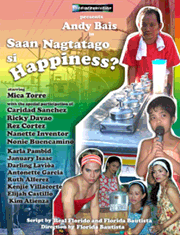
Saan Nagtatago Si Happiness
Directed by: Florida Bautista and Real Florido
Cinemalaya’s ‘Saan Nagtatago Si Happiness?’ by Florida Bautista and Real Florido is a semi-musical comedy film that revolves around the life of Tikyo (Andy Bais), a middle-aged ice cream vendor searching for his long-lost mother. Marked by its yellow tones and handheld shots, the film tackles the conflict between finding his mom (Caridad Sanchez) and courting the girl of his dreams (Darling Laviña) and how he attempts to become successful in winning these two women of his life. Tikyo believes that true happiness will come to him if he’ll be successful in winning the two women. He must find his way to happiness in as much as the other characters who are struggling for it as well.
At the age of 50, finding dreams and happiness isn’t part of Tikyo’s everyday life anymore. More than offering a helping hand to other people in need, Tikyo lives day by day with the simplest things in life as selling sorbetes, his only source of living. Given the kind of life he has somehow accepted, everything seems just fine for him. But things start to change when he gets the news that his mother is still alive. His life takes a different turn from then on. He does everything to find the woman of his life from enduring long lines in TV studios to raiding radio stations to seeking the help of a lunatic and even hysterical fortune teller. Then, his world spins into confusion when the charming girl of his dreams, Sara, comes into the picture. He becomes torn between finding his mother and pursuing the young woman’s heart. With the help of his good friend Nene (Mica Roi Torre), a child suffering from scarcity both in material and emotional aspects at her very young age, the two become more serious confidantes ready to help each other during their best and worst times and everything else that come in between.
The warm tones of the film tend to become overboard at times – especially because there are minor inconsistencies in the color grading. There are some underexposed and washed out shots, too. Some of the scenes with low-key lighting do not look fluid to the film’s entirety. The editing is very poor. The whole film becomes too straining to the eyes because the cuts are not seamless. Moreover, the cuts are generally abrupt and it lacks a certain kind of mastery of the language with the way the scenes are presented. Even the significant scenes needing enough establishing of emotions become wasted primarily because of the wrong cuts. More often than not, the parts with dialogues are mainly what are shown on screen without enough care on giving some breathing space to emancipate the right emotions from silence and from the characters’ supposed emotional take-off. The visuals lack proper timing to establish or sustain a mood and it generally yields to being verbose. Moreover, a number of shots tend to break the 180 degree rule in an audio-visual production – making the audience either confused with the shots or lose touch of the supposed fluidity of the cuts. Overall, the visuals become the major weakness of the film as it seems more of a rough cut because of the rawness of the editing. Furthermore, like the usual weakness Pinoy films tend to have, the sound of this film has minor problems too. There are some uneven sound elements and certain shots have no ambient sound. A number of discontinuities are very apparent as well – including the shot of Nene holding the bars of a gate and reaching something to the ground – the discontinuity is very obvious.
All the said weaknesses won't make the film sink into oblivion. Giving due consideration to the fact that the filmmakers are first timers, it somehow shows how important it is to make careful judgments and ask for consultations in order to effectively film a promising vision and story. At this point of time, a major re-editing can really help much in order for the film to gain its redemption.
With the aura of the film overall, the production team seem to have real fun during the shoot. It reflects the kind of 'personality' the film projects. And this happy mood radiated helps to somehow pull off some heart for the audience amidst its technical weaknesses.
The story is promising. On a personal note, a revamp should be made in order to achieve technical quality. The performances are generally good. Lou Veloso, Nanette Inventor and Rez Cortez render such funny scenes. However, a deeper characterization of the supporting characters may also help uplift the story. The songs meant for the film are complementing. However, there is something vague with its stand as a semi-musical. Though there are some entertaining dance numbers, something is lacking on this part.
Media Revolution’s 'Saan Nagtatago si Happiness?' is a promising story. I just hope that the makers of the film would look into the brighter side of the spectrum and take objective results from what they have read on this article for the betterment of the film. The filmmakers may consider to re-editing, or if possible, they may deem it necessary to reshoot some scenes or add some shots that would help the film. And in doing so, the 'pursuit for happiness' can really push itself to the surface.


 Posts
Posts


No comments:
Post a Comment